Joshua House residents’ homelessness
The Life ListJoshua House residents’ homelessness is presented not as a single circumstance shared in the same way by every guest, but as housing insecurity encountered among women with varied lives and needs. Through Brett Bohlinger’s student Sanquita Bell, the shelter’s daily routines, and Mercedes’s account of losing her house after an adjustable mortgage became unaffordable, the novel makes homelessness concrete. It also places Brett’s own search for housing beside the residents’ experiences, shifting her attention from fearful judgments about unfamiliar neighborhoods toward the people who live there.
Shelter Life and the Residents
Brett first encounters the conditions surrounding one of her students while traveling to Amina Adawe’s home. The address leads her to an abandoned-looking tenement: a toddler comes through a splintered entry door, and inside, the hallway is murky and dank, littered with food wrappers and cigarette butts. The starkness of the building unsettles her, especially in contrast with the private office and comforts she left behind at Bohlinger Cosmetics. The scene is Brett’s apprehensive view of a particular home, not a description of every shelter resident’s circumstances; its importance is that the work brings her into contact with material conditions she had not previously confronted so directly.
At Joshua House, the residents are called guests and share a managed household with explicit routines. When Brett stays overnight, Jean Anderson explains that the shelter is at full capacity, that guests have access to the house until seven in the evening, and that the kitchen closes afterward. Children must be in bed by nine, the television goes off at eleven thirty, and each guest retreats to her own quarters. The bed assigned to Brett is a twin bed whose sheets are changed daily; she is expected to strip it in the morning, before Amy Olle relieves her at eight. These details show the shelter as both a place of refuge and a communal space organized around rules, children’s needs, and staff handovers.
A Thanksgiving Meal at Joshua House
Brett’s relationship with Sanquita Bell gives her a reason to return to Joshua House beyond her teaching work. After preparing a Thanksgiving meal, she calls ahead and finds Sanquita waiting at the door. Brett carries the food inside over three trips. The spread includes a whole turkey with stuffing, sweet potato casserole, fruit salad, cranberry sauce, tomatoes, and pies, rather than the turkey loaf the women had eaten earlier. Sanquita helps place it on the kitchen counter, where the other women gather.
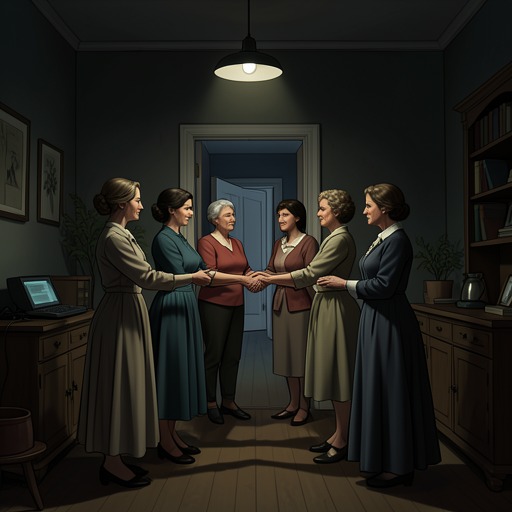
Tanya, Mercedes, and Julonia help unload the food while the rest lean in to see what Brett has brought. Their response makes the meal a shared occasion rather than a private gesture between Brett and one student. She already recognizes most of the women’s faces and knows some of their names, a small measure of familiarity that contrasts with her earlier sense of being out of place. The scene does not erase the residents’ housing insecurity; it shows the ordinary social bonds and welcome that persist within the shelter.
Different Routes into Housing Insecurity
When Brett later tells Brad Midar about Joshua House, she describes most of its residents as ordinary women who have fallen on hard times, distinguishing them from the few she says struggle with mental illness. Mercedes is her concrete example. A single mother, Mercedes was caught by an adjustable mortgage: when the interest rate rose sharply and she could not sell her house, she had to walk away. Someone directed her to Joshua House, where she and her children found a place to stay. Her account links shelter residence to a financial chain of events rather than to a fixed personal identity: homeownership did not protect her family once the mortgage became untenable.
Brett’s description is limited to the women she knows and the story Mercedes shares; the residents are not reduced to one cause or one portrait of homelessness. The presence of children, the shared routines, and the residents’ varied circumstances all remain part of the picture. Mercedes’s experience also gives particular force to the shelter’s practical role: it offers her family somewhere to stay after they have lost the house they could no longer afford to keep.
Brett’s Changing View of Home
Brett’s own housing search runs alongside her growing involvement with Joshua House. While looking at listings, she finds that some properties in Little Italy and University Village do not match their appealing advertisements. She is dismayed by a cement-block building with a boarded window and by a rental yard strewn with old tires and a rusted ironing board. The search makes housing insecurity immediate for her, but her reactions also reveal how readily she associates unfamiliar South Side neighborhoods with danger and disappointment.
Later, driving to Pilsen, Brett sees Mexican businesses and artwork and recognizes something in the neighborhood’s inhabitants: people searching for a better life, as she is. When she hears the story of a mother and daughter who saved enough for a down payment on a foreclosed house and spent seven months fixing it up, she begins to draw a comparison with her own mother, then checks herself. Their circumstances are not the same, and the encounter leaves her newly aware of her own good fortune. She moves into a small Pilsen apartment, furnishing it with modest pieces that include an old double bed, a cherry dresser, and a secondhand lamp.
The juxtaposition does not make Brett’s housing search equivalent to the residents’ loss of a home. Instead, it places her movement through unfamiliar neighborhoods beside other people’s efforts to secure shelter, and gradually complicates her initial fear and resentment. Joshua House remains part of that change: through Sanquita, Mercedes, and the other women gathered around a Thanksgiving meal, Brett encounters residents as individuals with homes, children, financial histories, and community ties—not merely as a category of need.